Pricing
Coworking versus a conventional office lease: a comparison
Compare coworking with an office lease through equivalent space, total commitment, control, responsibilities and exit terms.
Choose between coworking and a conventional office lease by matching the space to the team’s needs, then comparing the commitment and who runs the premises. Coworking suits a business when its available space and services meet the work requirement; a lease suits one that needs defined premises and can take on their setup and ongoing obligations.
Coworking may provide ready-to-use space and shared services, while a lease can give a business more scope to shape its premises, subject to the agreement. Neither is automatically cheaper or more flexible.
Compare equivalent space
Base the comparison on peak attendance and the need for private work, meetings, storage, visitors and access. A business.gov.au location guide also recommends weighing size, layout, facilities, permitted use and future growth.
Coworking can provide shared desks or private offices, with access depending on the product. Regus lists coworking day passes, day offices, meeting-room bookings and access plans; a shared desk is not equivalent to a leased private office if the team needs an enclosed room every working day.
A conventional lease is for defined premises, with the area and permitted fit-out set by the agreement. It gives the business more opportunity to shape the layout, but the business must consider the space needed for its activities, equipment and storage, as well as any approvals for its intended use.
If the team needs occasional space or can work within the coworking offer’s access and room arrangements, coworking may meet the need without a dedicated office. If it needs a particular private layout every day, a lease may fit better.
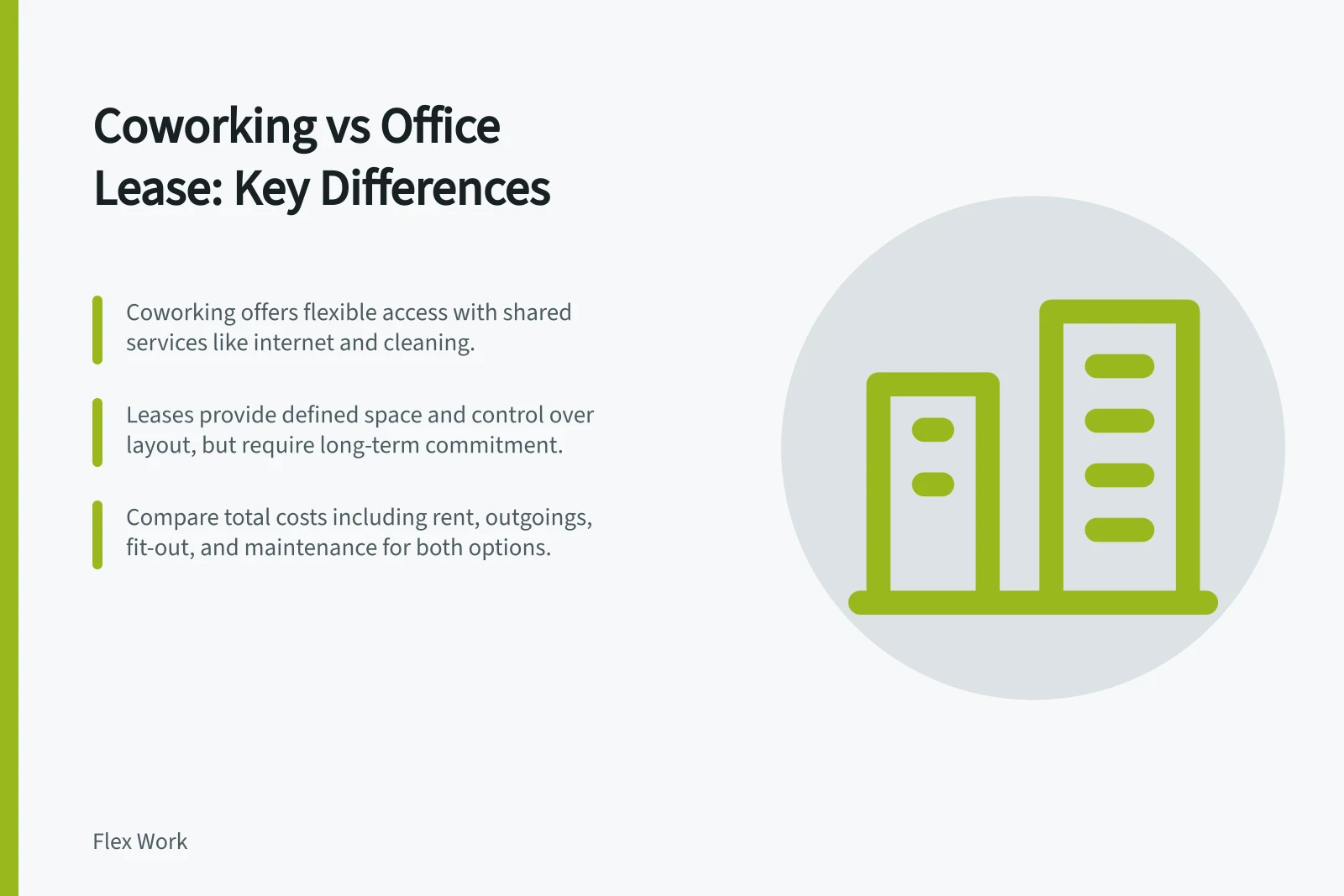
Coworking vs Conventional Office Lease: Key Differences
- Space TypeShared desks or private offices (flexible access)
- Access RequirementsDepends on membership plan; may include day passes or scheduled access
- Private Work AreaAvailable in private offices; not guaranteed with shared desks
- Leased PremisesDefined space with fixed layout and permitted fit-out
- CustomisationLimited by operator; cannot alter layout without approval
- Control Over LayoutHigh – business can design layout subject to lease terms and landlord approval
Compare the full commitment
Coworking is usually provided through a membership or licence rather than a conventional commercial lease. Terms may be month-to-month, and some arrangements allow a business to scale up or down; check the actual term, exit notice and any limits on access.
Include the membership fee and any separately booked rooms, day offices, guest access, storage or other services the team needs. The total depends on the selected offer and use, so compare the written terms for the same period.
Lease terms are negotiated and can be short or long. A short term can leave a business at risk of not recovering its investment, while a long term can provide stability but commit it to rent even if it cannot trade.
For a lease, include rent, outgoings, utilities, fit-out and maintenance, plus any other charges specified in the terms. In Queensland, possible additional charges include lease-registration fees, mortgage-consent fees and authority-approval costs.
In NSW, a cash bond is not required for a commercial lease, but parties can lodge one with the NSW Government’s Retail Bond Scheme. Confirm whether a bond is required for the proposed arrangement and how it will be held.
Rules differ by state and premises use. Victoria’s Retail Leases Act 2003 may apply based on use, including to premises providing services to other businesses; the Victorian Small Business Commission explains the retail-premises test. Queensland has the Retail Shop Leases Act 1994, and relevant Western Australian laws include the Property Law Act 1969 and Commercial Tenancy (Retail Shops) Agreements Act 1985.
Have a suitably qualified adviser review legal or financial terms that affect the decision.
Pros and Cons of Coworking vs Lease
- Coworking – ProsLow upfront cost, flexible terms, scalable usage, included services (cleaning, internet, meeting rooms)
- Coworking – ConsLimited control over environment, potential for noise, variable access depending on plan
- Lease – ProsStability, full control over layout and branding, long-term cost predictability if locked-in
- Lease – ConsHigh upfront costs (fit-out, bond), ongoing rent and outgoings, less flexibility to scale down
Compare control and responsibility
In coworking, the operator sets rules for shared areas and provides the services stated in its offer. The business follows those rules and checks that access, internet, cleaning and room-booking arrangements suit its work.
With a lease, the business has more scope to set its internal layout, subject to the agreement and any landlord approval. It must establish who arranges suppliers and responds to faults; in Queensland, commercial leases usually require tenants to maintain premises in good repair, while structural maintenance is usually the landlord’s responsibility.
Choose coworking when its space, access terms and shared-service arrangements meet the team’s needs. Choose a lease when a defined layout or greater control is worth taking on the setup, maintenance and longer-term commitment.
For either option, compare the exact space, expected spending, change and exit terms, services and responsibilities before signing.
How to Choose Between Coworking and a Lease
- Assess Space NeedsDetermine peak attendance, need for privacy, storage, and visitor access
- Compare Commitment LevelsEvaluate total cost including fees, outgoings, fit-out, and exit clauses
- Review Control and ResponsibilitiesDecide whether you prefer operator-managed services or full control over premises
- Seek Professional AdviceEngage a solicitor or accountant familiar with Australian commercial property laws