Pricing
Part of Coworking service quality
Reviewing whether a service promise matches actual delivery
Audit coworking claims against membership terms, real use and service records, then resolve unclear or unmet promises.
Compare a coworking claim with the membership entitlement and what members experience when they use it. Keep the wording a prospective member saw, check the agreement and site rules, then examine delivery during the hours and conditions the claim covers. Resolve any gap by changing the service, the description or both.
Reviewing a coworking promise against delivery
- Capture the promise in contextCollect website, proposal, tour, welcome and staff explanations with dates
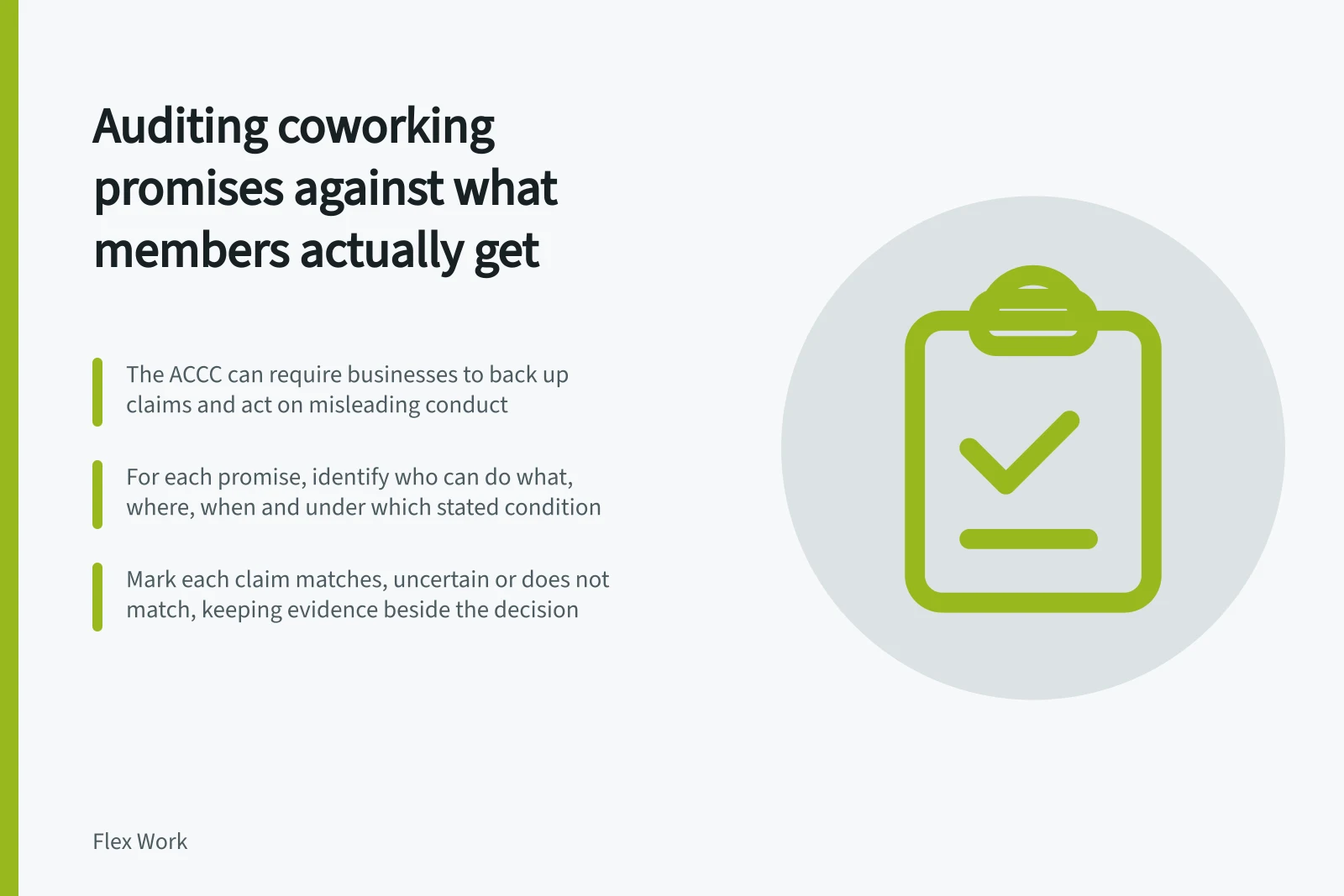
- Turn wording into a checkIdentify who can do what, where, when and under which stated condition
- Compare delivery at key momentsCheck an ordinary arrival, a busy booking period and an unstaffed period if covered
- Mark each claimMatches, uncertain or does not match as currently delivered
- Resolve gapsChange the service, the description or both; notify current members of material changes
Capture the promise in context
Collect the current website description, proposal, tour material, welcome information and relevant staff explanation for the plan and site. Record the date and surrounding wording. 'Meeting rooms available' gives different impressions depending on whether nearby text explains an allowance, booking limit or separate charge.
The ACCC accepts reports about possible misleading or false claims and can require businesses to back up claims they make about their products or services. It may investigate and take compliance or enforcement action if a business misleads. It does not resolve individual disputes or provide legal advice. This is general guidance; an internal audit does not decide whether a particular claim breaches the law.
Turn wording into a check
For each promise, identify who should be able to do what, where, when and under which stated condition. Compare that expectation with the membership and site rules. If the wording is vague, record the likely reader impression and seek clarification from the team responsible for the offer.
Example promise / Evidence needed
- 'Quiet workspace'
- Location, call rule and experience during normal use
- 'After-hours access'
- Eligible members, entrance, hours and help route
- 'Meeting rooms'
- Booking rights, availability, allowance or charge, and equipment
- 'On-site support'
- Staffed hours, response channel and staff responsibilities
These are audit prompts, not claims about an operator. An amenity photograph does not establish that every member can use the facility under every plan.
Compare delivery and resolve gaps
Check the moments that matter: an ordinary arrival, a busy booking period and an unstaffed period if the promise covers one. Review observations, member reports and service records. A single success cannot prove consistent delivery; a complaint needs investigation before its cause is stated as fact.
Mark each claim matches, uncertain or does not match as currently delivered, and keep the evidence beside the decision. Give uncertain items a specific next check. For a delivery gap, assign an owner and a condition for completion.
If the service cannot support broad wording, revise the description so prospective members can see the material limitation.
Tell current members about a material change affecting their use. Check their existing agreement before treating revised marketing wording as a change to their entitlement. Keep the previous wording, reason for the change and effective date, then recheck the claim when the service or membership changes.
Delivery moments to test
- An ordinary arrival
- A busy booking period
- An unstaffed period if the promise covers one