Access
Part of Coworking location and access
Checking transport and parking during a workspace visit
Use a site visit to check the transport route, parking conditions and entrance arrangements for a proposed coworking space.
Use a workspace visit to check the arrival your team would make. Travel at a relevant time, follow the route to the correct entrance and inspect the proposed parking option. Record what you observed and what the operator still needs to confirm.
Prepare one realistic arrival
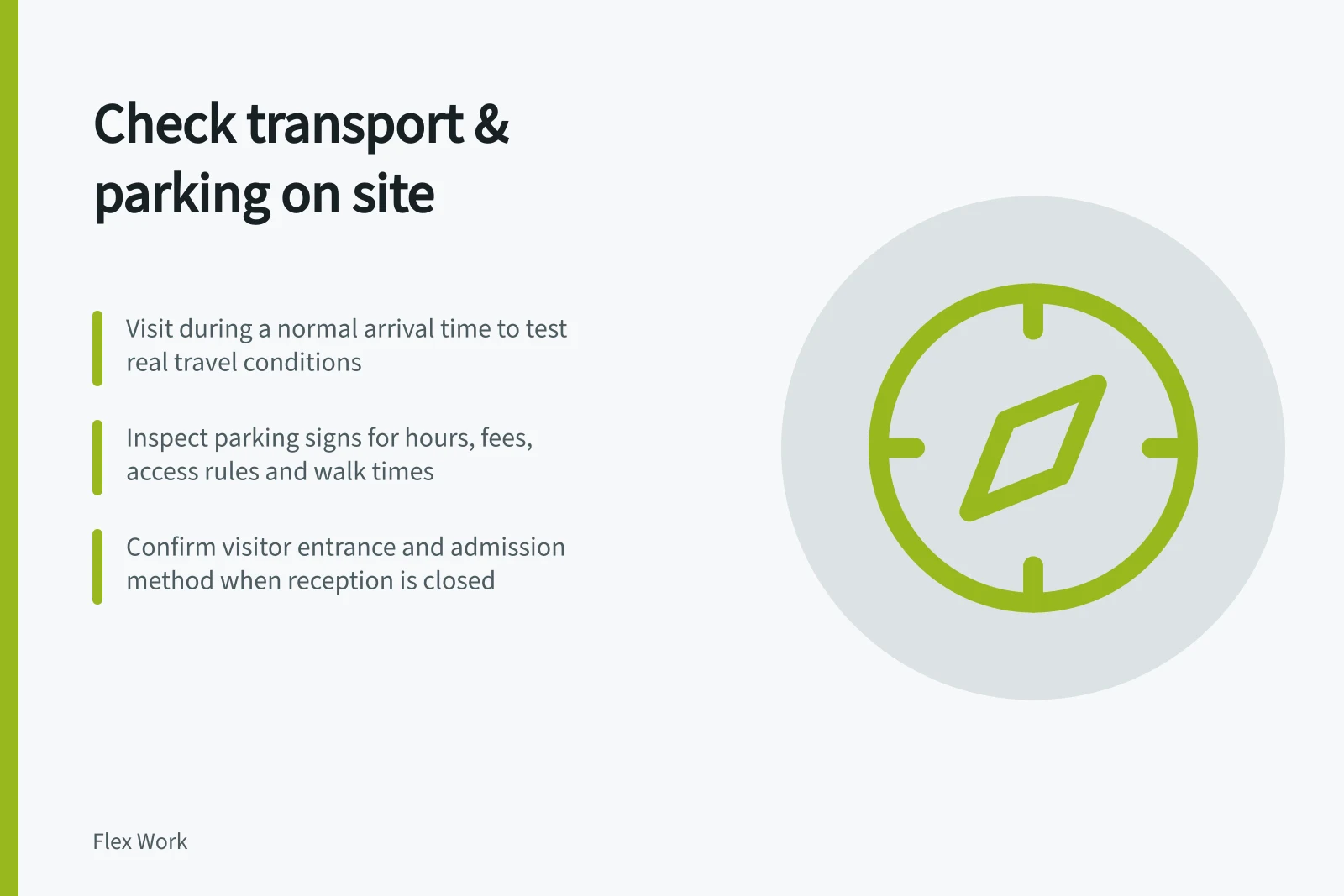
Choose a normal arrival time and, if relevant, a busy team-day time. Check the official transport planner for services and disruptions. Identify the stop, station or car park you intend to use and a possible alternative. Ask the workspace operator which entrance visitors should use and whether the proposed membership includes any parking.
Walk from the stop or station
Follow the route from the stop to the building instead of judging distance from a map pin. Note the walking time, crossings and signs. If people will arrive after dark, check lighting and wayfinding at that time. Find the correct entrance and ask what changes when reception is closed.
Where someone needs a particular accessible journey, check current transport service and facility information, then assess the street route and entry with that person's input. Transport for NSW's Trip Planner offers filters, real-time tools and accessibility support, and advises planning ahead with maps, alerts and support. A filtered trip does not establish that the street route or building meets an individual's needs.
Inspect the parking option
Locate the specific space or car park proposed for staff or visitors. Read its signs and operator conditions. Record permitted days and hours, time limits, payment, entry and exit hours, and the walk to the workspace. Check whether a loading bay or short drop-off is being described as parking for a full visit.
Rules vary by place. NSW guidance, for example, says parking restrictions may be shown on signs or road markings and can vary by time. If relying on a map of metered spaces, check the posted conditions and current charge: the City of Sydney says fees on its parking map are guides, not exact charges at every meter.
A commuter car park also may not be available for office use; free parking at Transport for NSW Park&Ride sites depends on an eligible public transport trip and a time limit.
Pros and cons of using Park&Ride car parks for office use
- Free parking at Park&Ride sites (if eligible)
- pro
- Requires an eligible public transport trip
- con
- Time limits apply (e.g. 4 hours)
- con
- May not be available for long-term office use
- con
Parking fees in Sydney (City of Sydney data)
- $3.00Average hourly rate (metered zones)
- 2hoursMaximum stay (in most zones)
Resolve the gaps in writing
| What you saw | What to ask the operator |
|---|---|
| Parking appears nearby | Are any spaces included or reserved, and for whom? |
| The entrance was open | Which entrance and credential work at the team's usual hours? |
| A stop is close | Which route should visitors use when reception is closed? |
| A visitor can arrive | Where may they wait or park, and how are they admitted? |
Date the visit record and separate observations from operator claims. One visit does not establish conditions for every workday. Repeat a critical check at another relevant time if parking demand, services or entrance arrangements may differ.