Community
Part of Coworking service quality
Collecting actionable member feedback
Ask specific questions, capture useful context and turn coworking member feedback into checked service changes.
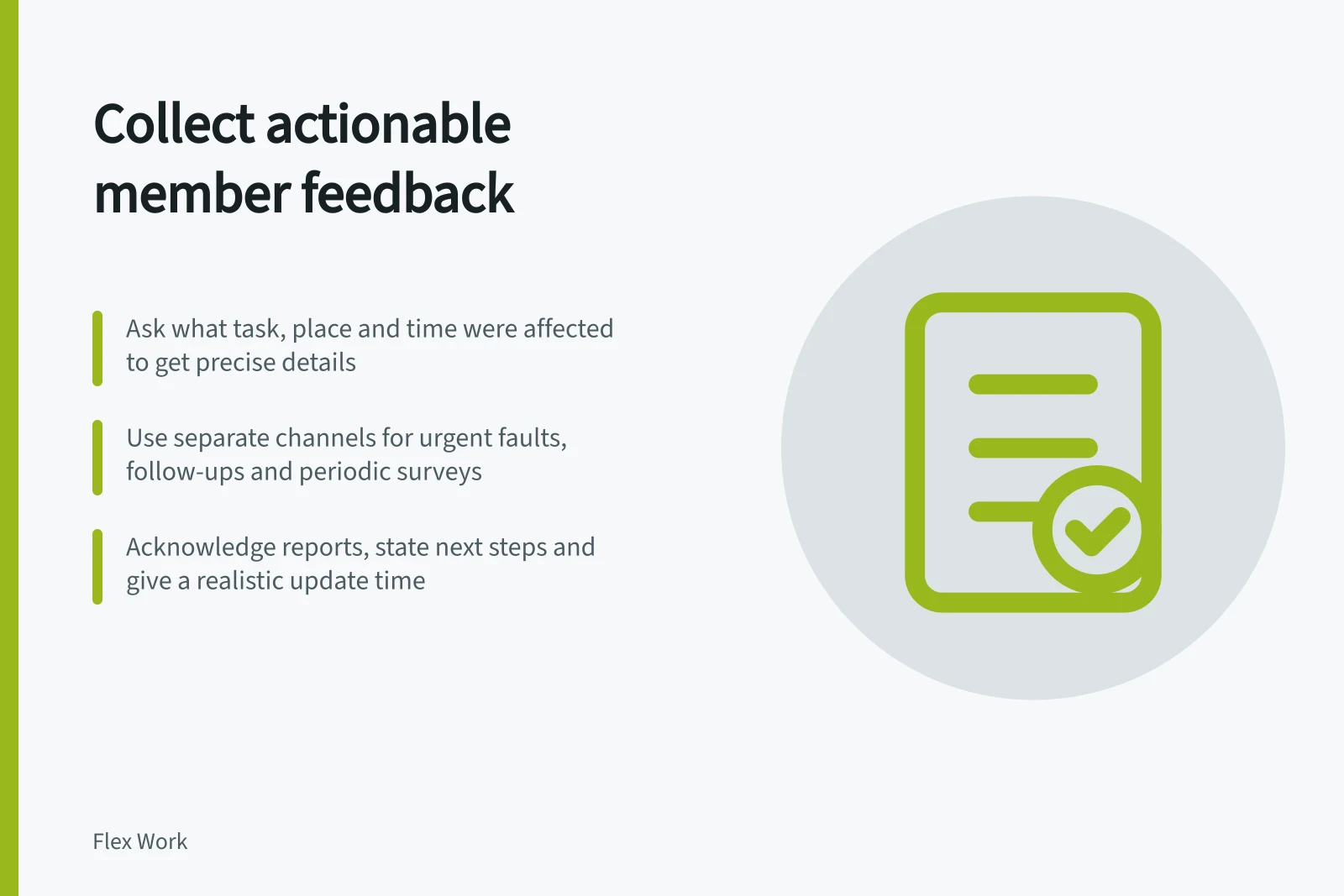
Ask about a specific part of the working day, let members report problems when they occur, and tell them what happened next. A useful report identifies the affected task, place and time, without requiring a long satisfaction survey.
Give each channel a purpose
Keep a live route for faults and interruptions, including failed entry or an unusable facility. Use a short follow-up after onboarding or a reported fix to check whether the service works. Use a periodic survey to find broader patterns, such as difficulty finding a place for calls or focused work.
Tell members when each channel is monitored, including outside staffed hours. An urgent access report needs a route that can reach the site's responder. Australian business guidance recommends easy feedback channels and a record of commitments made while handling a complaint.
Ask for detail that supports action
A useful prompt is: What were you trying to do, where and when did it become difficult, and what happened instead? For a recurring issue, ask how often it happens. Let members describe the effect rather than diagnose the cause.
Collect a name or contact method when a reply or individual remedy needs it. An anonymous option may help members raise concerns, but explain that it can limit personal follow-up.
Check whether the channel is genuinely anonymous: a signed-in form or retained identifiers may reveal the sender. For businesses covered by the Australian Privacy Principles, collection and anonymous dealings have rules and exceptions; coverage and the circumstances must be checked.
Interpret reports alongside records
Group feedback by service, location, time and outcome. Where appropriate, compare a room complaint with booking or closure records. Keep experience separate from cause: 'the booth was unavailable at 2 pm' is a report; a booking-system fault still needs checking.
Show the response count when summarising a survey. Voluntary replies may not represent all members.
Look for recurring detail across comments, fault records and observations, while responding promptly to a serious barrier even if only one person reports it.
Close the loop
For an individual report, acknowledge the effect, state the next step and give a realistic update time. After a change, ask whether the original task now works. For a broader pattern, tell members what was heard, what changed and what remains unresolved without exposing another member's details.
End the review with a decision: act, investigate, clarify a rule or retain the arrangement with a reason. Assign an owner and a date to check the result.
Best practices in feedback handling
- Response rate benchmark
- Voluntary replies may not represent all members – track participation rates
- Applicable regulation
- Australian Privacy Principles (APPs) govern collection and anonymised dealings
- Action required for serious issues
- Respond promptly even if only one person reports a major barrier