Access
Part of Coworking capacity and occupancy
Measuring desk use rather than sold memberships alone
Count occupied and usable desks at matching times, then compare bookings and memberships without confusing them with physical use.
Count occupied usable desks at defined times, then compare with the desks available to that group at the same time. Keep memberships separate: they measure access sold. A member may be away; someone on site may be using a room rather than a desk.
Define the desk pool
For shared desks, identify which work points are usable at each observation. Record closures and seats allocated to another use. Do not include a dedicated desk in the shared pool unless its holder's agreement and the site's rules make it available. For dedicated desks, report allocation and physical use separately.
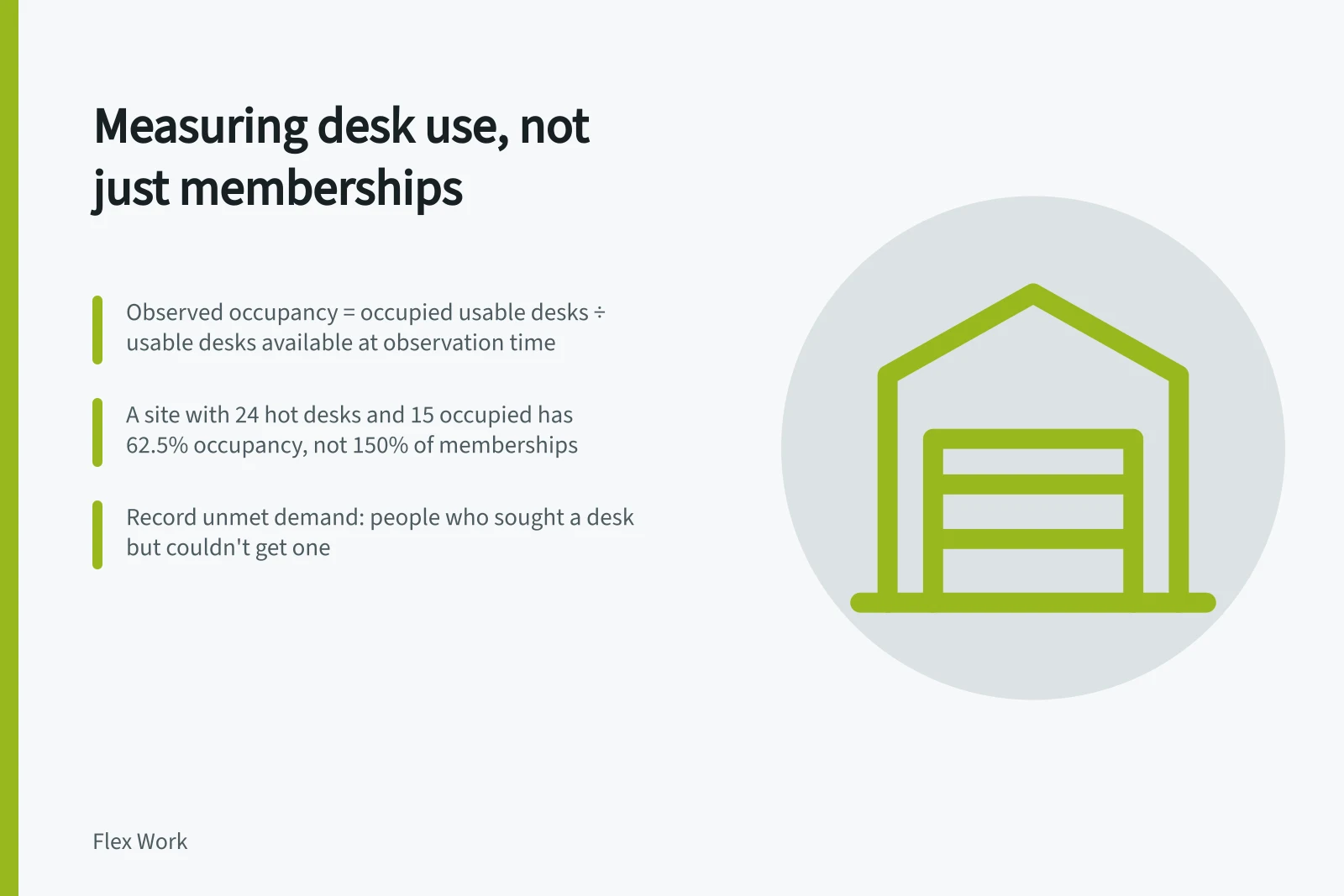
Observed occupancy for a comparable desk pool is occupied usable desks ÷ usable desks available at the observation time. State how the count treats a desk whose user has stepped away briefly, and apply that rule consistently. Record people who sought a desk but could not obtain one: occupied desks alone cannot reveal unmet demand.
Steps to Accurately Measure Desk Use
- Identify usable desks in the shared pool at observation timeExclude dedicated desks unless agreed and permitted for sharing
- Record closures or reassignmentsDo not count desks allocated to other uses (e.g., meeting rooms)
- Track unmet demandRecord people who sought a desk but could not obtain one
Reconcile different records
| Record | Useful for | Limitation |
|---|---|---|
| Membership list | Access sold | Does not show simultaneous desk use |
| Desk bookings | Intended use | Can include unused bookings and omit walk-ins |
| Entry count | People arriving | Does not show departures or desk use |
| Desk observation | Seats in use | Reflects only the times observed |
A useful time-block record has the usable desk count, occupied desk count, confirmed bookings and known requests that could not be served. Sold entitlements provide context, not the denominator for physical occupancy.
Suppose a site has 24 usable hot desks and 36 active memberships. If 15 hot desks are occupied at a Tuesday midday observation, observed desk occupancy is 15 ÷ 24 = 62.5%. Membership count does not make occupancy 150%. This hypothetical observation says nothing about other hours or people unable to find a desk.
Use of Different Records in Desk Monitoring
- Membership List
- Measures access sold — not physical use
- Desk Bookings
- Shows intended use — may include unused bookings or miss walk-ins
- Entry Count
- Tracks arrivals — no data on departures or desk usage
- Desk Observation
- Captures seats in use — only reflects observed times
Sample relevant times
Repeat counts across ordinary and busy periods using the same definitions. Mark holidays, events, closures and changes in the desk pool. A quiet morning cannot establish that an afternoon team day has spare capacity.
Use aggregate counts where they answer the capacity question. If person-level bookings, entry logs or monitoring records are used, define their purpose and check applicable privacy and surveillance rules. The OAIC's workplace monitoring guidance concerns employers monitoring staff; its application to a coworking arrangement cannot be assumed. The Australian Privacy Principles apply to covered entities, with requirements depending on the information and circumstances.
Report observed use by time block with any unmet demand. Investigate a gap between bookings and observations before changing the number of desks.
Recommended Timing for Desk Observations
- Morning (e.g., 9:00–10:00 AM)Typically quieter; not representative of peak demand
- Midday (e.g., 12:00–1:00 PM)Peak usage period — ideal for assessing capacity
- Afternoon (e.g., 2:00–3:00 PM)Check for post-lunch demand and variability
- Include holidays, events and closuresMark changes in desk pool availability for accurate analysis